
Typed schemas
Define tables and validators with defineTable and v. Rows, queries, and
index columns are fully type-checked end to end.
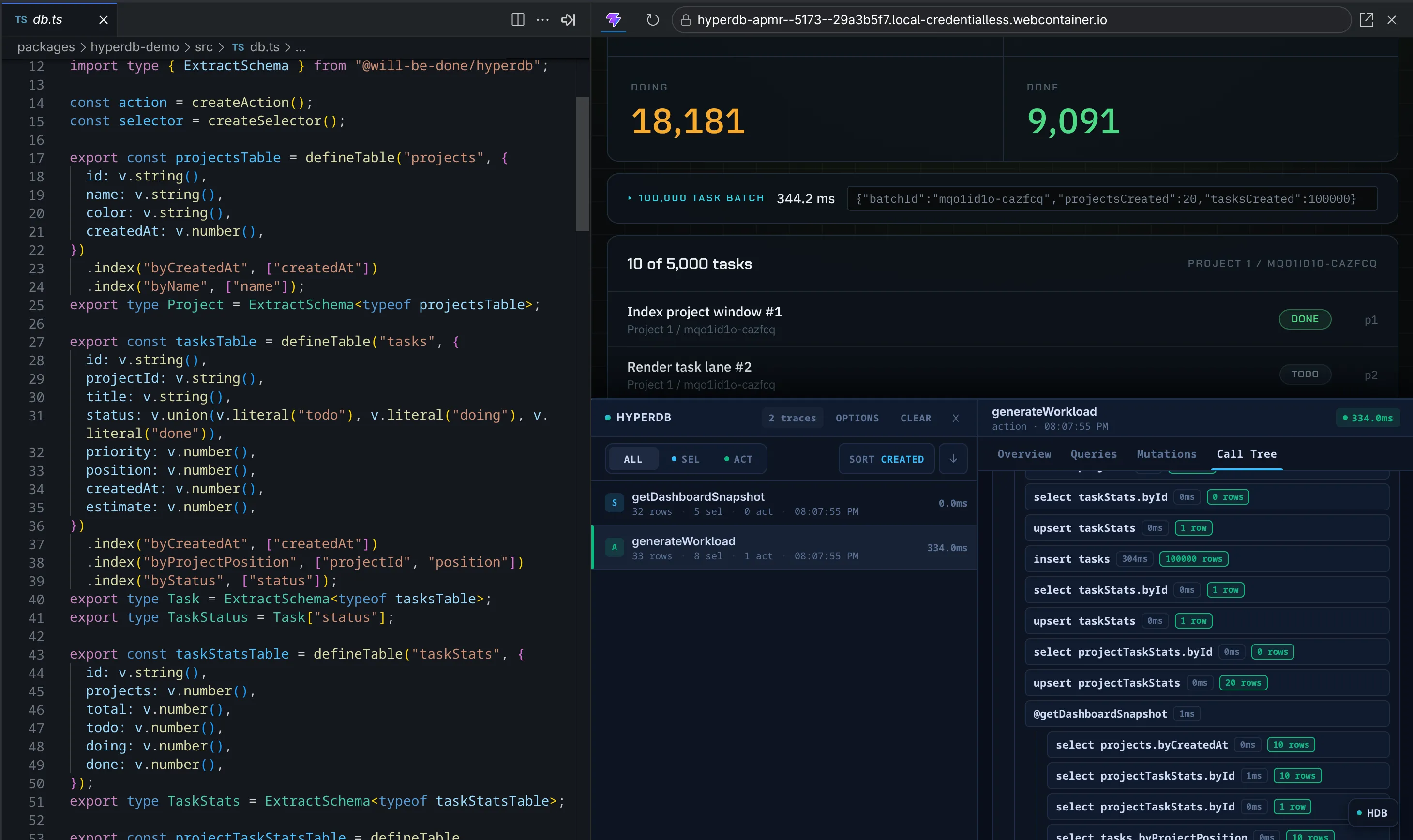
HyperDB brings the developer experience of a backend like Convex to a database that can run in the browser and on the server. You describe your data with typed schemas, read it through reactive selectors, and change it through transactional actions. The same slice of schema, selectors, and actions can be shared by the client and backend; only the storage driver differs. Why HyperDB? gives the technical background.
Typed schemas
Define tables and validators with defineTable and v. Rows, queries, and
index columns are fully type-checked end to end.
Indexed queries
Query through B-tree and hash indexes with a fluent, type-safe builder.
Every table index is a B-tree, so sorted inserts and range scans stay O(log n). This fits local-first fractional ordering, where reordering an item
touches a single token instead of rebuilding the list.
Reactive by default
Selectors are cached and subscribed. They re-run only when a mutation touches a range they actually scanned.
Runs everywhere
The same schema, selectors, and actions run in the browser (in-memory, IndexedDB, WebAssembly SQLite) and on the server (native SQLite). On the backend the runtime reads only the rows a selector touches instead of hydrating the whole dataset into memory.
JavaScript selectors and actions
Write selectors and actions as ordinary JS (loops, conditionals, function calls) on both client and server. HyperDB gives you fast indexed lookups underneath, not a query language to learn.
Plain immutable data
Components get plain, frozen rows, with no proxies and no observer()
wrapper, so it composes with React’s rendering model directly.
React & devtools
First-class React hooks plus an in-app devtool that traces every selector and mutation into a call tree.